Main research lines
Quantum Realism &
Quantum Darwinism
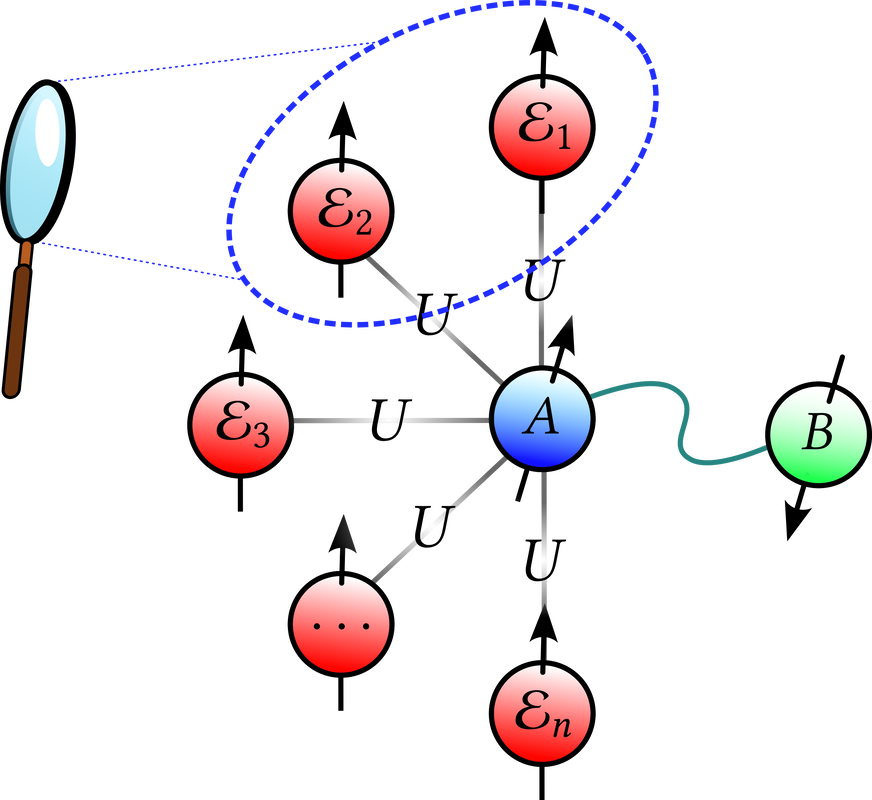
The measurement problem is crucial for understanding the transition from quantum to classical. In my works, I adopt the view that projective measurements establish the realism of observables, even when the outcome is not revealed.
Selected works on this subject and its connection with Quantum Darwinism:
- Quantum realism: axiomatization and quantificationA. C. Orthey, R. M. Angelo. Phys. Rev. A 105, 052218 (2022)
- High-dimensional monitoring and the emergence of realism via multiple observersA. C. Orthey, P. R. Dieguez, O. Makuta, R. Augusiak. Phys. Rev. A 111, 012220 (2025)
Self-testing
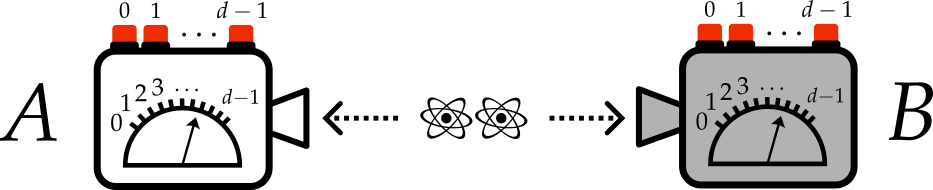
Self-testing is a certification procedure for quantum measurements and states based on the maximal violation of Bell and steering inequalities.
Selected works:
- Certifying classes of d-outcome measurements with quantum steeringA. C. Orthey, R. Augusiak. New J. Phys. 27, 064501 (2025)
- Almost device-independent certification of multipartite quantum states with minimal measurementsS. Sarkar, A. C. Orthey, G. Sharma, S. Halder, R. Augusiak. Phys. Rev. Applied 25, 034019 (2026)
- A universal scheme to self-test any quantum state or measurementS. Sarkar, A. C. Orthey, R. Augusiak. Nat. Phys. 22, 446 (2026)
Quantum Walks
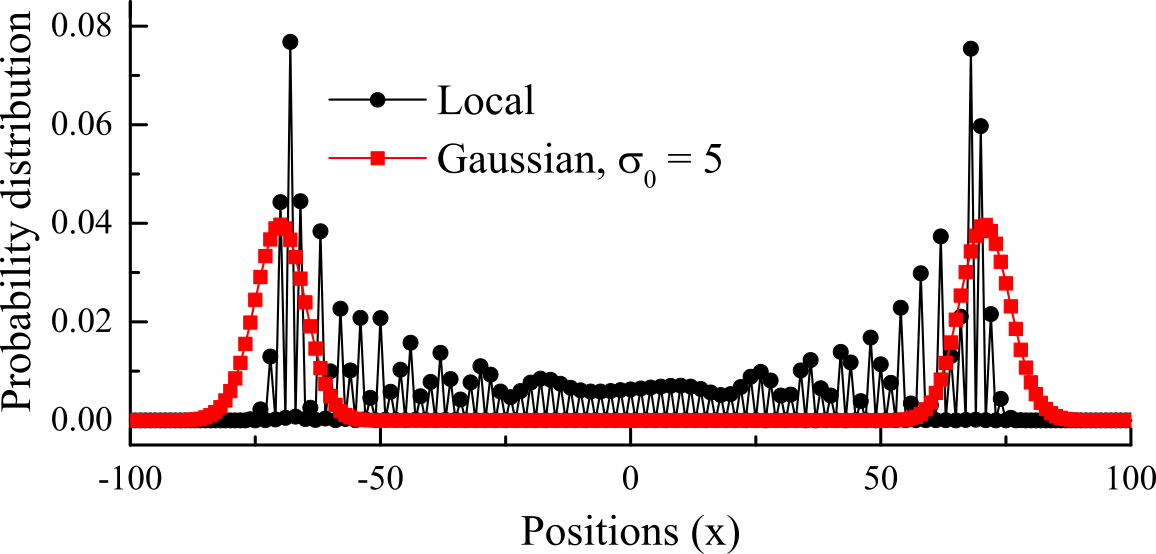
A quantum walk is the quantum analogue of the classical random walk problem in statistical physics. When superposition is allowed to the walker, entanglement and ballistic spreading appear, making this system useful for faster quantum computing.
Selected works:
- Asymptotic entanglement in quantum walks from delocalized initial statesA. C. Orthey, E. P. M. Amorim. Quantum Inf. Process. 16, 1 (2017)
- Nonlocality, quantum correlations, and violations of classical realism in the dynamics of two noninteracting quantum walkersA. C. Orthey, R. M. Angelo. Phys. Rev. A 100, 042110 (2019)